Osama Bin Laden
Osama bin Laden
Osama bin Laden—also known as Usama bin Laden—was a violent terrorist and mass murderer who used bombings and bloodshed to advance his extremist goals.
After founding the terrorist organization al Qaeda, he engineered a series of attacks in multiple countries that killed thousands of men, women, and children, often ordinary citizens just going about their daily lives.
Bin Laden’s Extremist Roots
Born in 1957 in Saudi Arabia, Bin Laden was the son of a wealthy Saudi businessman.
Following the Soviet Union’s invasion of Afghanistan in late 1979, bin Laden began providing financial and logistical support to the Islamic fighters battling the Soviets.
In 1988, after Soviet forces were defeated and withdrew from Afghanistan, bin Laden founded an organization called al Qaeda, or “the Base,” to continue the cause of jihad (holy war) through violence and aggression.
Al Qaeda soon began raising money, setting up training camps, and providing military and intelligence instruction in such areas as Afghanistan, Pakistan, and Sudan. Under bin Laden’s direction, al Qaeda started launching attacks and bombings in various nations to further its violent aims.
During this time, bin Laden was becoming increasingly hostile to the United States. In particular, he opposed the U.S. military presence in Saudi Arabia and Somalia and sought to drive our nation’s personnel out of these areas by force.
After centering his operations in Sudan in the early 1990s, bin Laden began formulating plans to attack the West with an evolving, deadly new brand of jihad.
Bin Laden and other members of al Qaeda also began issuing fatwas—rulings on Islamic law—indicating that attacks on the U.S. and its citizens were both proper and necessary. Bin Laden later openly declared war on the United States.
Osama (or Usama) bin Laden, former head of al Qaeda and architect of the 9/11 attacks.
Osama bin Laden
أسامة بن لاد ن

Initial Attack on U.S. Soil
On February 26, 1993, Ramzi Yousef—a young extremist who had trained in one of bin Laden’s camps—led the first major Middle Eastern terrorist attack on American soil by planting a truck bomb beneath the World Trade Center. The plan to topple both towers failed, but six people were killed and more than a thousand were injured.
Following the connections, investigators soon uncovered and foiled a second terrorist plot to bomb a series of New York landmarks.
The FBI also learned that Yousef was planning more attacks—including the simultaneous bombing of a dozen U.S. international flights—in concert with his uncle, Khalid Sheikh Mohammed, who later joined al Qaeda.
Ultimately, Yousef was captured and multiple terrorist operatives were arrested and imprisoned for the World Trade Center bombing, deepening bin Laden’s disdain for America.
In approximately 1996, bin Laden and his supporters returned to Afghanistan, where an alliance with the Taliban government provided a secluded safe haven for al Qaeda to train recruits and plan attacks.

East African Bombings and Indictment
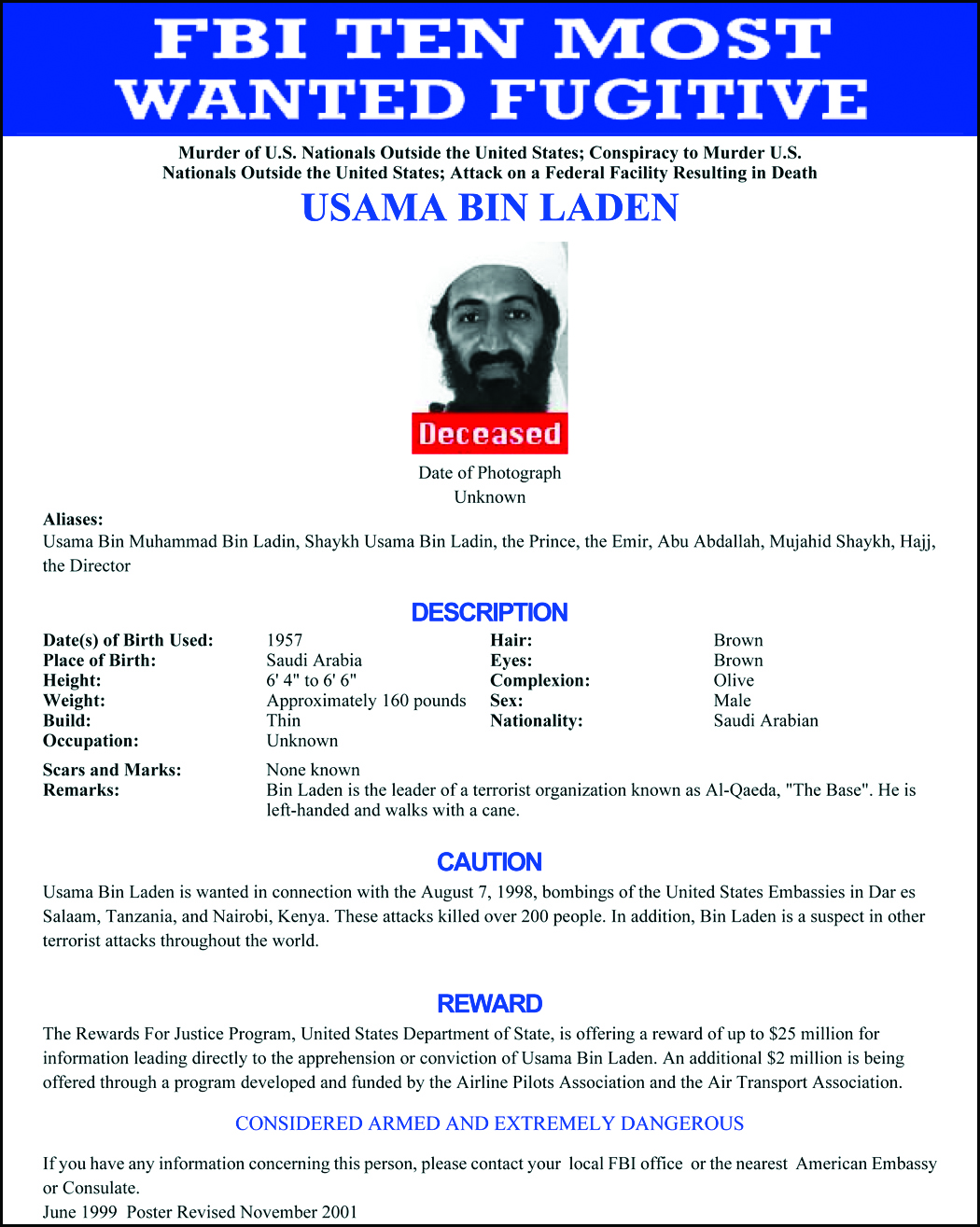
One of terrorist organization’s major plots came to deadly fruition on August 7, 1998, when al Qaeda operatives bombed U.S. embassies in Dar es Salaam, Tanzania and Nairobi, Kenya.

The near simultaneous attacks killed more than 200 American, Kenyan, and Tanzanian citizens and wounded another 4,500 people.
These attacks were directly linked to bin Laden, who was indicted for his role in the bombings on November 4, 1998, and again in June 1999. The charges included the murder of U.S. nationals outside the United States, conspiracy to murder U.S. nationals outside the United States, and attacks on a federal facility resulting in death.
A number of top al Qaeda operatives were ultimately captured and convicted for their roles in the bombings. The attacks led to ramped up anti-terror efforts by the U.S. and the FBI, which created its first Counterterrorism Division in 1999, consolidating its many anti-terrorism efforts and capabilities.
On June 7, 1999, the FBI placed Osama bin Laden on its Ten Most Wanted Fugitives list, citing his connection to the 1998 attacks in East Africa.
As a new century dawned, al Qaeda continued its violent attacks. Some major plots failed, including a scheme to bomb the Los Angeles airport on the eve of millennial celebrations.
On October 12, 2000, however, terrorist operatives set off a small boat filled with explosives next to the USS Cole during its fuel stop in Yemen. The attack killed 17 Navy sailors, injured nearly 40 other crew members, and severely damaged the ship.


Comments
Post a Comment